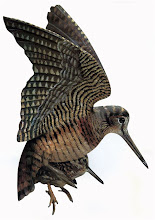
Satellites (through Argos-CLS ) and Platform Transmitter Terminals, PTTs (through Microwave Telemetry Inc ) are the main tools we have dealt with in our different experiments to track the Eurasian woodcock.
Both leading organizations in the World have changed and improved their technology and methodology since we started our research in 2003. Argos has put more satellites in orbit and developed better techniques for the accuracy of the locations. MTI has produced new PTTs with much less weight and much better technology for their charge.
MTI:
In 2003, there were no available PTTs for the tracking of Eurasian woodcocks. The smallest PTT was a PTT-100 18 gram Solar PTT. (Nowadays the smallest is a 5 gram solar PTT.)
In 2004 most of the information that was available in internet was analyzed. At the end of 2004 we knew that MTI was preparing new solar PTTs of 12 grams. So, our first experiment in 2006 was with three PTTs of 12 grams and duty cycles of 48/10 for one PTT and 72/10 for the other two. We had strong problems with interferences in Europe, something that MTI and Argos did know.
Our next experiment, in 2007, was with PTTs of 9.5 grams, duty cycles 48/10 and TIs (transmission interval) of 45 and 60 seconds. This was our main finding at that time: the charge of the PTTs is the key point, not only against interferences but also to give better and more emissions.
The next experiment was in 2008, with two prototypes, equipped with special solar cells, given as a present by MTI. The PTTs have a special duty cycle of 55/8. One of the main aims of this project was to see the performance of the new PTTs against the European interferences.
Clear consequences of the use of this new technology during 2008: (a) the charge was greater than in our previous experiments; (b) the emissions’ data were much better in quality and quantity; (c) the frequency of the emissions was more regular than before.
The final result was net: the European interferences were overcome with both PTTs, during all the time the tracking lasted and in all the different atmospheric circumstances.
From 2008 on, in all our experiments we have used 9.5 gram solar PTTs, duty cycle 48/10, TI of 60 seconds, with MG (mortality ground ), and with the new technology developed by MTI in 2008.
Solar Argos/GPS PTTs:
Up to now, 2011, there is no possibility to track woodcocks with Argos/GPS PTTs, since the smallest solar Argos/GPS PTT weights 22 grams . In any case, at the prototype level, MTI has produced one of 15 grams . It is very possible the next one to be one of 11/12 grams .
Recovery of PTTs:
Here a very useful technique for the recovery of PTTs we used in Karelia: Finding a lost PTT-Part 2, explained by Paul Howey .
ARGOS:
Location classes:
In Argos’ manual one can see, among some other issues, the different satellites launched and the date of their launching (2.3), also the location classes (3.4) .
In 2011, CLS introduced a location processing algorithm that takes into account platform dynamics and the use of a bank of Kalman filters to calculate positions . In Anne-Marie Bréonce’s words (of Argos), “…
with the new Argos location algorithm we hope you could get more and accurate data .”
On the other hand, with ‘flat’ ellipses, the estimated error is more accurate . Even more, for the accuracy of class A and B locations, apart from the direction of the ellipse , one should take also into account the GDOP . (In fact, about the Class B locations with Kalman filtering, the ‘Semi-major axis’ is a good index to judge the quality of a Class B one-message location.)
More information:
Here more information available about optimizing Argos system performance, Kalman filtering, location accuracy and the ‘flat’ ellipse error .
Multi-pass location:
When there is not enough data per satellite pass to produce any location, by using multi-satellite processing, we could have an idea of the approximate location .
Addenda:
WXtrack - Satellite tracking:
This program is designed to predict the tracks of satellites both as paths above the earth, and as images produced by these satellites when scanning the ground .
Accuracy of A and B class locations:
According to Argos , “
Class A & B location may be accurate. (…)
Some users have experimentally tried to answer this question and provided interesting hints. We are confident that approaches of this type will help provide interesting guidelines to enhance practical use of this type of locations.”
Some time ago, some of us developed a method to know the accuracy of A and B class locations in special circumstances .
More here:
http://es.scribd.com/doc/73037491/The-tracking-of-the-Scolopax-rusticola-with-radio-telemetry-via-satellite-methodologyjoseba felix tobar-arbulu (PhD in Engineering)


 The PTT and one of the fir trees